
16-Hour Utah Electrical Continuing Education Course – 2023 NEC
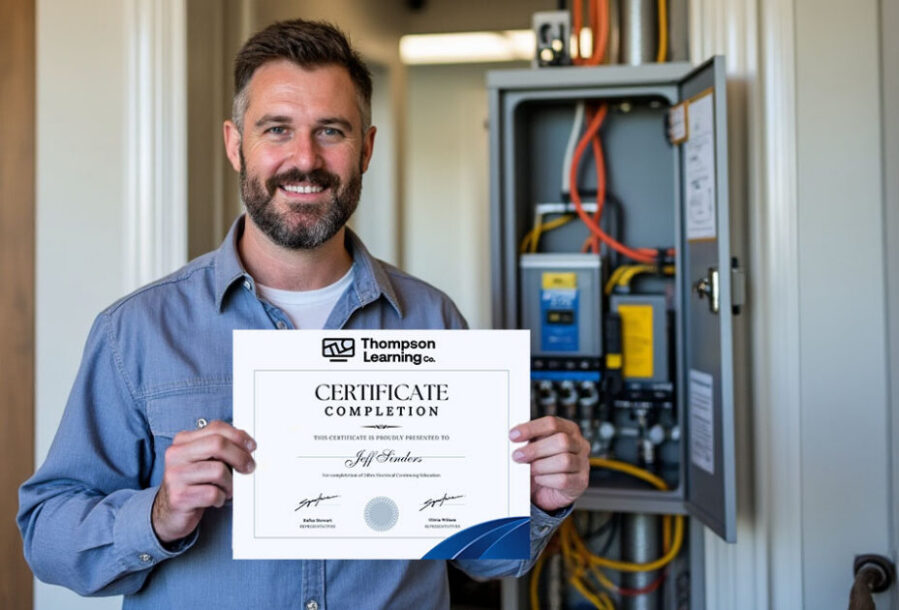
Study the Utah 16-hour continuing education course online at your own pace, covering 2023 NEC updates and 2024 NFPA 70E workplace safety. The course is offered for master, journeyman, residential and master residential electricians.
Review Utah DOPL’s CE requirements and approved-course search for current course information.
Choose your course format
- Full 16 Hour CE Course: Complete 16 hours of online coursework.
- By the Hour: Purchase the additional continuing-education hours you need.
-
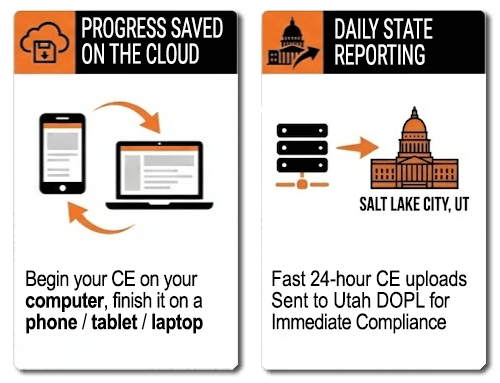
Next-Day Registry Sync: We report your hours within 24 hours. Your license stays “Green” automatically.
-
Instant digital certificate + 10-year record storage. (audit-ready peace of mind)
Company discounts are available. Call 866-685-8564 for a quote.
For licensing exam study, explore Utah electrician exam preparation.
-

Approved 16-Hr Continuing Education Provider. Licensed by the Utah Division of Occupational and Professional Licensing (DOPL).
Course ID# 22567

|
BBB A+ Rating As of 2/11/2026 Click for Profile |
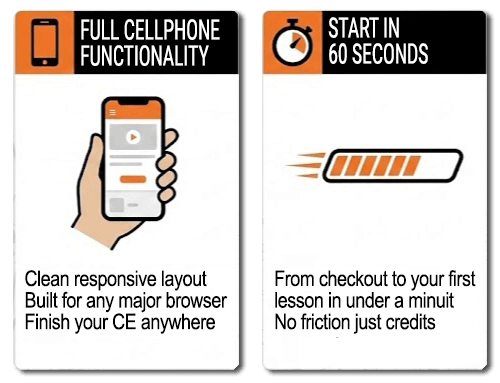
Course Breakdown: 16-Hour Approved 2023 NEC Code Updates
 Course ID: # 22567
Provider: Thompson Learning Co.
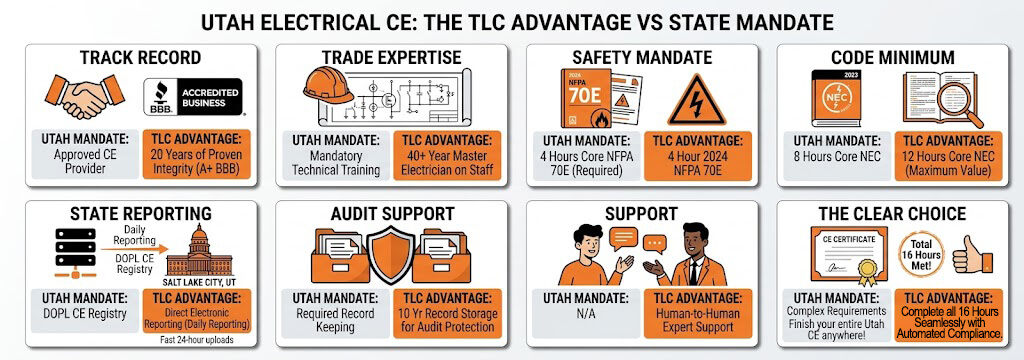
This comprehensive program provides the full 16 hours of core continuing education required for Utah electrical license renewal, precisely divided into one 12-hour NEC and one 4-hour NFPA 70E Safety section to meet 16-hour state mandates.
Part 1: (REQUIRED) 4 Hours – 2024 NFPA 70E Electrical Safety in the Workplace:
Lesson 1: NFPA 70E (Chapter 1 – Work Practices)
- Article 90: Introduction: A breakdown of the new mandatory scope at 90.1, defining the legal boundaries of safe work.
- Chapter 1: Safety-Related Work Practices: Foundational principles of hazard ID and the 2024 focus on “Human Factors” like fatigue and distraction.
- Article 100: Definitions: Navigating the 2024 consolidated definitions for “Boundary,” “Qualified Person,” and “Working On.”
- Article 105: Application of Safety Practices: Defining employer/employee responsibilities and the mandatory hierarchy of risk control.
- Article 110: General Requirements: Deep dive into the massive 2024 changes to the Electrically Safe Work Condition (ESWC) policy.
Lesson 2: NFPA 70E (Chapter 1 – Continued)
- Article 120: Establishing an ESWC: The mandatory 8-step process for safety, including “Live-Dead-Live” testing and LOTO precision.
- Article 130: Work Involving Electrical Hazards: Managing Energized Electrical Work Permits, approach boundaries, and PPE Categories 1-4.
Lesson 3: NFPA 70E (Chapter 2 – Case Studies & Maintenance)
- Case Studies: Real-world OSHA incident analysis showing the link between equipment neglect and arc flash catastrophes.
- Article 200: Safety-Related Maintenance: Why safety practices fail without proper maintenance and how neglected gear increases incident energy.
Lesson 4: NFPA 70E (Chapter 3 – Special Equipment & Annexes)
- Article 300: Maintenance for Special Equipment: Safety protocols for battery banks, electrolytic cells, and high-energy DC systems.
- Annex A through S: The Pro Toolbox: Practical field guides for incident energy calculations (Annex D) and work permit templates (Annex J).
Part 2: 12 Hours of 2023 NEC:
To complete this requirement, please choose twelve individual one-hour modules from the comprehensive pool provided below:
General Wiring & Equipment: One Hour Each Lesson (10 Hours)
General Requirements
- Articles 90-110: Introduction, purpose, and general installation requirements.
- Articles 200-210: Grounded conductors and branch circuit requirements.
- Articles 215-230: Feeders, outside circuits, and service entrance standards.
- Articles 235-245: Branch-circuit/feeder overcurrent (235) and overvoltage (245) protection.
- Article 250: Grounding and bonding—critical system and equipment safety.
Wiring Methods & Equipment for General Use
- Articles 300-315: General wiring requirements and new Medium Voltage (315) standards.
- Articles 320-398: Specific wiring methods (AC, MC, NM) and all raceway/conduit types.
- Articles 400-408: Flexible cords, switches, receptacles, switchboards, and panelboards.
- Articles 409-425: Industrial panels, motors, generators, and space-heating equipment.
- Articles 426-495: De-icing, transformers, capacitors, and equipment over 1000V.
Special Occupancies, Equipment & Conditions (10 Hours)
Special Occupancies
- Articles 500-506: Hazardous (classified) locations and Zone-based safety systems.
- Articles 511-516: Commercial garages, hangars, and motor fuel dispensing facilities.
- Articles 517-525: Health care facilities, assembly occupancies, and temporary venues.
- Articles 530-590: Studios, audio/IT equipment, and temporary installations.
Special Equipment
- Articles 600-660: Electric signs, industrial machinery, and office furnishings.
- Articles 665-682: Induction heating, swimming pools, and bodies of water.
- Articles 685-695: Integrated systems, solar PV, fuel cells, wind, and fire pumps.
Special Conditions & Communications
- Articles 700-705: Emergency, standby, and interconnected power sources.
- Articles 706-722: Energy storage (ESS), DC microgrids, and critical operations (COPS).
- Articles 724-840: Class 1 (724), Class 2/3 (725), Fire Alarm (760), and Communications (800+).
Compliance Verification Notice
This curriculum is designed to fulfill the “12+4” split requirement in Utah. By completing the full 16-hour course, licensees automatically satisfy the minimum 8 hours of NEC Code Updates required by Section R156-55b-304.

TLC-ProTip: Beating the “November Midnight Deadline” – R156-1-308c
The Administrative Trap: The DOPL portal often faces extreme traffic in the final 72 hours of the cycle. There is zero grace period for the 11:59 PM MST deadline on November 30.
The Penalty: Missing the cutoff triggers an “Expired” status, requiring manual reinstatement, late fees, and a legal work stoppage.
Metta’s Advisory: Aim for a NOVEMBER 1ST FINISH LINE. Completing your hours early allows our team to verify your data sync with the DOPL registry well before the holiday rush. This protects you from technical portal outages beyond your control.
TLC-ProTip: Audit Insurance & 4-Year Retention – R156-55b-304(4)
The Compliance Gap: Utah law holds the licensee responsible for maintaining proof of completion for 4 years (two renewal cycles). DOPL frequently triggers random audits.
Metta’s Advisory: If you cannot produce a certificate during a Board audit, your license can be suspended—regardless of whether you actually took the class. We maintain your records for 10 years. Save our office number (866-685-8564) as “License Support” in your phone; if you’re hit with an audit, just call us for immediate access to your verified records.
The Fine Print: Thompson Learning Co. (TLC) professional support services—including the 24-Hour Reporting, Audit Insurance, and 10-Year Secure Document Storage—are strictly for registered TLC clients. We physically cannot store or verify certificates for continuing education (CE) lessons completed with any other provider. To ensure your records are secure and audit-proof, we only support credits actively completed on the TLC platform.
Frequently Asked Questions: Utah Compliance Guide
Section A: Licensing Eligibility & Exemptions
- Q: Can I begin my Continuing Education today?
- A: Yes, you can begin your next round of Continued Education the day after your certification card renews. The State allows 2 years to complete the CE requirements.
- Q: How often am I required to renew my Electrical License
- A: Every 2 years – expiration date is November 30th of every even year.
- Q: I recently graduated from an approved apprenticeship and received my license. Am I exempt from CE requirements for 2026?
- A: Generally, yes. Under Utah Admin. Code R156-1 Code R156-1-308c(6), if you were licensed by examination during the current two-year cycle (specifically those licensed within the last 12 months of the cycle), you are not required to complete CE for your initial renewal. If your license was issued after November 30, 2025, you are currently in a “non-reporting” cycle and will not need to file credits until the 2028 renewal.
- Q: Does the “First-Cycle Exemption” apply if I just upgraded from Journeyman to Master?
- A: No. This is a common point of administrative failure for Utah licensees. Upgrading your license rank (e.g., from Journeyman to Master or Residential to Full) is a status change, not an initial entry into the trade. Board rule R156-55b-304 requires you to complete the full 16-hour requirement to maintain your active status, regardless of when the upgrade occurred during the cycle.
- Q:How soon before my card is set to expire can I submit my renewal application to the State
- A: You can now submit your paperwork to the Board up to 90 days before your due date. Your card will be renewed for two years from the expiration date listed on your electrician License.
- Q: – FOR EXISTING STUDENTS: I completed your 16-hour Continuing Education program. When do I receive my certificate of completion?
- A: You will receive your certificate of completion via email within 24 hours of completing your lessons. This is for your records only we will update the DOPL Registry with your completion within 24 hours.*Please call us at 866-685-8564 if you have not received your certificate. (Double check your spam email box)
Section B: Course Mechanics & Technical Alignment
- Q: Does this 16-hour course satisfy the Utah “8+4+4” split?
- A: Yes. Unlike other states, Utah mandates a specific “Core” breakdown under R156-55b-304(2): 8 hours of NEC Code and 4 hours of NFPA 70E (Safety). Our 16-hour package is engineered to cover the 8-hour NEC update, the mandatory 4-hour Safety component, and 4 additional Core hours. This ensures you over-satisfy the “Core” requirement and the total 16-hour mandate simultaneously, ensuring zero friction with the DOPL online registry
- Q: When will the Division of Professional Licensing (DOPL) be notified of my completion?
- A: We utilize RUSH REPORTING to sync your data with the Utah DOPL CE Registry within 24 HOURS of course completion. You can verify your hours have been posted by visiting the official Utah CE public lookup. You will also receive a digital certificate via email for your 4-year mandatory record retention.
Professional Disclaimer: While Thompson Learning Co. (TLC) monitors the Utah Administrative Code (R156) year-round, licensing requirements and fees are subject to change by the Utah Electrician Licensing Board. Licensees are responsible for verifying their current status via the official DOPL website.
Utah Electrician’s Resource Center
| CATAGORY | OFFICIAL RESOURCE |
|---|---|
| Renewal Portal | MyLicense One (UtahID) |
| CE Registry | DOPL CE Public Lookup |
| Verification | Verify a Utah License (LLV) |
| Legal Rulebook | Utah Admin. Code R156-55b |
| Out of State | Licensure by Endorsement Information |
Direct Support & Assistance
If you experience portal outages or UtahID linking errors, contact DOPL immediately to document your attempt:
- Phone: 801-530-6628 (M–F, 8 AM–5 PM MST)
- Toll-Free (Utah only): 866-275-3675
- Email: doplweb@utah.gov
- In-Person: Heber M. Wells Building, 160 E 300 S, Salt Lake City, UT 84111
Quick Compliance Checklist
- Electronic-Only Notifications: DOPL no longer mails postcards. Ensure your email is current in the portal to receive your registration code.
- Apprentices: You are not exempt. Apprentices must complete the full 16-hour requirement unless licensed within the last 12 months of the cycle.
- Reciprocity: Utah offers endorsement for Journeymen from states including AK, AR, CO, ID, MT, NE, NH, NM, ND, OK, OR, and others with equivalent standards.
Licensing requirements, fees ($84), and deadlines are set by the State of Utah and are subject to change. As a professional, you are responsible for maintaining your status via the official DOPL website.
Ready to Get Started?
-