
Preparing for the California contractor license exams takes a workable schedule, regular review and practice explaining why an answer is correct. This guide brings together study planning, test-day preparation, a multiple-pass approach and one worked practice example.
Most first-time applicants take Law & Business and a trade exam. C-61 applicants have no trade exam, and CSLB may approve other examination waivers. Follow the exams assigned to your application. Review the application process before planning your study. CSLB examination overview · California licensing requirements
Build your plan around the official exam guides
Download the free CSLB guide for Law & Business and your classification. Use its topic outline, approximate topic weights, sample questions and recommended references to create a study checklist. Record the topics you understand, the ones needing practice and the resources you will use. Official CSLB study guide directory
The Law & Business guide describes a closed-book, four-choice exam with one best answer per question, a provided calculator and no guessing penalty. Read your trade guide for its own content and test policy. Follow the current instructions for your assigned exam rather than relying on a fixed question count or a passing percentage from an older article. Current Law & Business study guide
Choose a scheduling approach that fits your preparation
CSLB refers accepted applications for testing. After your Notice to Schedule arrives, arrange each exam with PSI. You may book them on one day or on different dates. Each allows 3½ hours. The qualifying exams are taken in person. Confirm current centers and availability with PSI. CSLB scheduling FAQ · PSI scheduling
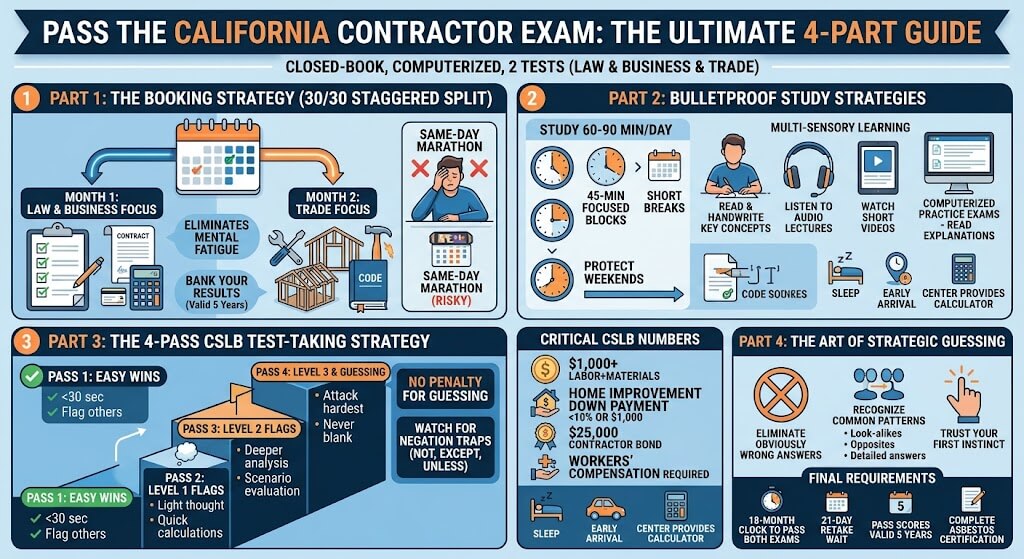
An optional 30/30 study plan
If two subjects at once feel difficult to manage, try a first study block of about 30 days for Law & Business, followed by about 30 days for your trade. Separate appointments can give each subject its own review period. Adjust the order and the length of each block to your current knowledge, practice results, travel and available test dates.
This is a planning example, and your study period may be shorter or longer. A same-day appointment can reduce travel, while separate dates can reduce the amount of material you review at once. Practise a long study session first if you are considering two exams on one day. Check your application deadline before choosing either arrangement.
Make regular study sessions manageable
- Start early. Set aside specific times around work and family responsibilities. A starting routine might be 60–90 minutes on study days, divided into roughly 45-minute sessions with a short break. Adjust it when concentration or practice results show that a different pace works better.
- Organize each session. Choose a topic from the official outline. Read its explanation, work through an example and then answer questions without looking at the material.
- Explain the answer. For each missed question, write the principle, rule, unit conversion or calculation you needed. Revisit that topic in a later session and try a fresh question.
- Use the formats that help you practise. Reading, handwritten notes, flashcards, diagrams, audio and short videos can be useful tools. Ask whether you can recall and apply the concept after using them. Use audio only when it is safe and you can give your surroundings the attention they require.
- Practise the computer format. Work through timed question sets and review their explanations. Track whether the problem was knowledge, calculation, reading or time management.
- Leave time to rest. Build breaks and days off into the schedule. Plan a broad review a few days before testing and a light review the evening before.
Keep a short error log with columns for the topic, your original reasoning, the corrected explanation and the date to review it. This gives the next study session a clear purpose.
Study important rules in context
The original guide highlighted a few California licensing numbers. Keep their conditions alongside them in your notes and verify the current rule in the official material.
| Topic | Study note |
|---|---|
| Minor-work exemption | The exemption applies to qualifying work below $1,000 in total labor and materials. A permit requirement or employing workers prevents its use even below that amount. Work cannot be split from a larger operation to claim the exemption. CSLB minor-work bulletin · 2026 license law, section 7048 |
| Home improvement down payment | The usual maximum is the smaller of $1,000 or 10% of the contract price. Read the contract rules and their stated exception. CSLB contract guidance |
| Contractor license bond | The required bond amount is $25,000. The premium paid to the surety is a separate cost. CSLB bond requirements |
| Workers’ compensation | Coverage is required for employees. C-8, C-20, C-22, C-39 and C-61/D-49 also require coverage or approved self-insurance without employees. Check the conditions for any claimed exemption. CSLB workers’ compensation requirements |
Prepare for test day
- Read your PSI confirmation and exam-specific bulletin. Plan to arrive at least 30 minutes early.
- Bring accepted, unexpired government photo identification, such as a U.S.-issued driver’s license or government-issued passport, with a name matching your application. Resolve a name mismatch with PSI before the appointment.
- Use the tutorial to practise answering and reviewing questions. Follow the proctor’s directions for permitted supplies and restroom breaks.
- Keep personal notes, devices and your own calculator outside the testing room. Follow the current security and approved-accommodation instructions.
For cancellation or rescheduling without losing the exam fee, PSI requires notice at least two days before the appointment. Use the PSI website or speak with a representative. Voicemail and email do not complete cancellation. Read the bulletin selected for your exam in the PSI program portal. PSI California contractor testing portal
Arrange disability accommodations and language support in advance. Spanish versions are available for selected exams, with approved translator arrangements governed by CSLB’s rules. Confirm the option for your exam before scheduling. CSLB accommodations and language information
Try a multiple-pass question strategy
Use this optional approach during practice and keep the version that helps you manage time. On exam day, follow the review controls demonstrated in the PSI tutorial and use only authorized supplies.
| Pass | What to do |
|---|---|
| 1. First reading | Read the full question and all four choices. Answer questions you can resolve promptly and mark or identify the others for review using the available controls. |
| 2. Short problems | Return to questions needing a quick calculation, a closer reading or a small amount of additional thought. |
| 3. Longer problems | Work through the remaining calculations and scenarios while watching the time available. |
| 4. Final review | Eliminate choices you can explain as incorrect, choose the best supported remaining answer and check that every question has a response. |
Slow down when a question uses NOT, EXCEPT, minimum or maximum. Identify what it asks before calculating or selecting an answer. Compare similar options against the facts in the question. Use a fact, a rule or corrected arithmetic when deciding whether to revise an answer.
Answer length, paired opposites and words such as “always” can help you notice a difference between options, but they do not establish which answer is correct. Check each choice against the question. The official Law & Business guide encourages answering every question because guessing carries no penalty. CSLB test strategy
A worked practice example
This original practice scenario demonstrates elimination and careful reading.
Question. A prime contractor and a separately licensed subcontracting business sign a subcontract defining the subcontractor’s work and payment. Which option best describes the relationship created by that agreement?
- An employer–employee relationship
- The labels “contractor” and “subcontractor”
- A contractual relationship
- No relationship
Answer C, a contractual relationship. The scenario expressly describes an agreement between separate businesses. Choice A introduces employment that the scenario does not state. Choice D conflicts with the signed agreement. Choice B repeats the parties’ roles, while choice C identifies the relationship the agreement creates. The reason for choosing C comes from the facts and the question’s wording.
After a practice question, write the explanation in your own words and test yourself with a changed scenario. That keeps the exercise focused on understanding.
Keep the application and exam deadlines separate
CSLB generally allows 18 months from application acceptance to pass required exams. Its FAQ says passing results remain valid for five years, and a failed exam has a 21-calendar-day retake wait. Score validity does not extend the application deadline. Use the dates in your notices and contact CSLB about your individual circumstances. CSLB application and exam-results FAQ
Applicants for an initial license also complete the asbestos awareness open-book exam before issuance. The online process is available after the application is posted. Its purpose is awareness and it does not authorize asbestos removal. CSLB asbestos awareness exam
Use the application guide to track the remaining paperwork alongside your study schedule. Application forms and instructions
When comparing preparation options, match the exact course, format and access terms to your needs. Choosing a contractor school · TLC California contractor courses
Official policies and links reviewed November 18, 2026. Follow your current CSLB notices and the PSI instructions for your assigned examination.